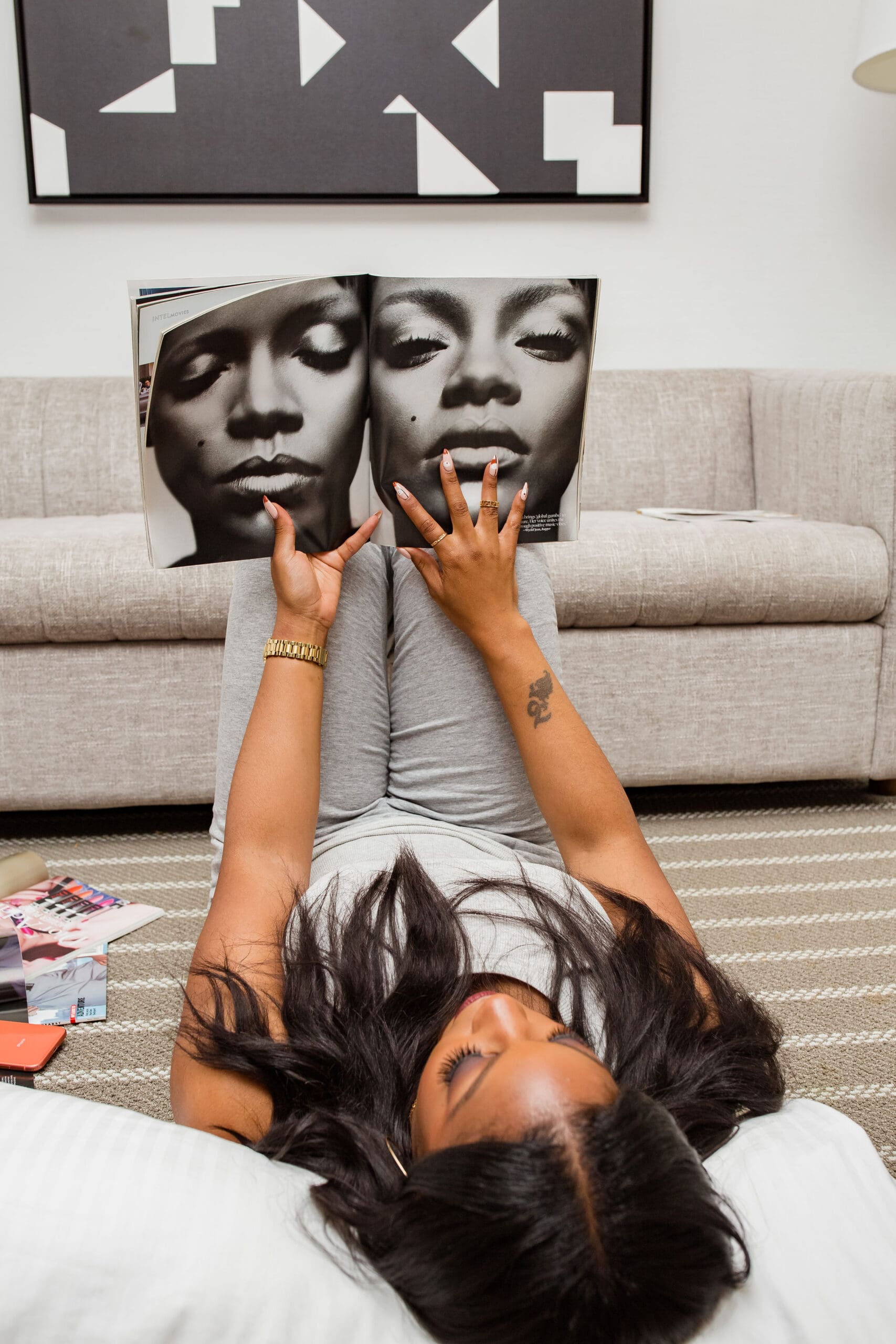
Production designer [Name] has built [a 1960s newsroom, a Paris apartment, and an entire small town] for the screen. Each one took a few months. Her own home, however, took [six] years.
“On a set, you know exactly who lives there,” she says. “At home, you’re still figuring it out.”
Hollywood has always relied on people like her. In fact, the Oscar statuette itself was designed by an art director, MGM’s Cedric Gibbons. So I asked production designer [Name] to let us inside the one set she never has to strike.

A Home Designed Like a Set
Every set starts with a character. Production designer [Name] approached her home the same way.
“I asked myself who lives here,” she explains. “The answer was someone who reads too much, collects strange ceramics, and never wants to leave the couch.”
As a result, every room tells part of that story. Nothing is there by accident, and nothing matches perfectly. “Real homes are layered over time,” she says. “That’s what makes them believable.”


The Living Room
The living room is where production designer [Name]’s home comes alive. Above the sofa hangs [a large abstract painting by a friend]. Meanwhile, the coffee table holds [a stack of art books and a vintage brass bowl].
Her favorite find sits in the corner: [a mid-century lounge chair] she found at [the Rose Bowl Flea Market] for [$80]. “The upholstery was destroyed,” she laughs. “But the bones were perfect. On set, we’d call that a hero piece.”
The Piece She Brought Home From Set
Every production designer has one. For [Name], it’s [a hand-painted ceramic lamp] from [Show/Film].
“We built an entire apartment around it,” she remembers. “When we wrapped, I couldn’t let it go to storage. So it came home with me.”
Today, it lights her reading corner every night. “It’s a little piece of that world,” she says, “in mine.”
What Production Design Teaches About Home
After all, a set has to look lived-in from every angle. So I asked production designer [Name] for the rules she brings home.
Start with a story. Decide who lives in the room before you buy anything.
Layer textures, not just colors. Linen, wood, metal, and wool make a room feel real on camera and in life.





Light it like a scene. Use three or more light sources at different heights, and never rely on one overhead fixture.
Give every room a hero piece. One object with a story does more than ten that match.
Edit like a set decorator. “If it doesn’t help tell the story,” she says, “it goes back to the truck.”
Shop Production Designer [Name]’s Sources
[Name]’s go-to sources: [Rose Bowl Flea Market], [a favorite vintage dealer], [a lighting shop], and [an online antiques site].
Some links in this story may be affiliate links. Every pick here was chosen by the professional featured, not by a sponsor.
Your Hero Piece
Every home has one object that tells its whole story. So tell me yours. What’s the piece you’d save in a fire? The best stories may appear in a future At Home feature.
With love,
Leah